One of the reasons for the flourishing of Islamic culture during the medieval period was its early emphasis on freedom of expression, first declared in the 7th century by Umar, the second Caliph, in the Rashidun Caliphate:
"Only decide on the basis of proof, be kind to the weak so that they can express themselves freely and without fear, deal on an equal footing with litigants by trying to reconcile them."
This is not the only example of such a declaration. Another can be found in a letter written by Ali ibn Abi Talib, the fourth Caliph, to Malik al-Ashtar, the governor of Egypt. In this letter, the Caliph advises his governor on the proper way to deal with the poor masses:
"Out of your hours of work, fix a time for the complainants and for those who want to approach you with their grievances. During this time you should do no other work but hear them and pay attention to their complaints and grievances. For this purpose you must arrange public audience for them during this audience, for the sake of Allah, treat them with kindness, courtesy, and respect. Do not let your army and police be in the audience hall at such times so that those who have grievances against your regime may speak to you freely, unreservedly, and without fear."
It is interesting that in this exhortation the Caliph implies that there are practical benefits as well as religious tenets to be considered. The governor should treat the masses with respect "for the sake of Allah," but the Caliph also implies that allowing free speech will improve the governor's rule. It is certainly not a religious doctrine that a ruler must listen to grievances against him, so there must be some political benefit to such a practice. One can surmise that people who are allowed to speak their minds freely make better subjects. If the people feel that they have a genuine dialogue with the ruler, they will more easily accept the conditions of his governance. They will not harbor resentment, and so will spend their energy in more productive pursuits than rebellion or political agitation. Repression is counterproductive in that it saps human energy. Unhappy, repressed people do not work as productively and they will seek an outlet for their frustrations. They will tend towards activities which threaten the status quo of the rule, and the ruler will feel forced to enact even greater repressions. It is a vicious cycle which need not exist.
Citizens of the Rashidun Caliphate were free to criticize the Caliphs because the head of state was just as bound by the rule of law as the citizens.
Freedom of speech was again declared during the Abbasid Caliphate by al-Hashimi, cousin to Caliph al-Ma'mum. He wrote this in a letter to a non-Muslim whom he was attempting to convert:
"Bring forward all the arguments you wish and say whatever you please and speak your mind freely. Now that you are safe and free to say whatever you please, appoint some arbitrator who will impartially judge between us and lean only towards the truth and be free from the empery of passion, and that arbitrator shall be Reason, whereby God makes us responsible for our own rewards and punishments. Herein I have dealt justly with you and have given you full security and am ready to accept whatever decision Reason may give for me or against me. For "there is no compulsion in religion" (Quran 2:256) .
This emphasis on the arbitration of Reason and the willingness to accept whatever conclusions reason may reach bears a strong resemblance to Socrates' attitude toward dialogue. The idea is that the true philosopher does not enter the dialogue with any preconceived notions which he holds above rational inquiry. All opinions offered on the subject are subject to discussion, argument, analysis, etc. If Reason is the only arbitrator (as opposed to emotion or rigid belief), then, by virtue of their shared reason, the interlocutors will reach a rational conclusion among themselves.
The idea of free rational inquiry extends into contemporary times as the concept of academic freedom. According to George Makdisi and Hugh Goddard, the "idea of academic freedom" in universitites was in fact "modeled on Islamic custom" as practiced in the medieval Madrasah system circa 9th century. Islamic influence was "certainly discernible in the foundation of the first deliberately-planned university" in Europe, the University of Naples Federico II, founded by Holy Roman Emperor Frederick II in 1224.
Makdisi and Goddard have a point. Islamic and Western/European cultures were not always so sundered as they are now. There was once a free flow of information and learning between them. For example, Greece and Hellenistic Rome gave Plato to Islam, and Islam later reintroduced translations of Aristotle to Europe. Aristotle had been largely unknown in Europe until that point. The concept of freedom of expression exemplifies the kind of philosophic interchange which once took place and which is still possible.
Tuesday, May 5, 2009

Monday, May 4, 2009
Mosul Suicide Bomb

I really can't understand how or why some people have so degraded themselves that they feel actions like this are acceptable.
Six people died in a suicide bombing in Mosul on Friday.
The bomb destroyed a legitimate military target. No, wait, that wasn't it... The bomb destroyed a nonmilitary but still justifiable target. No, unfortunately that's not it either.
The bomb was detonated at a coffee shop. Yes, you read that correctly: a coffee shop. O, what low and vile miscreants populate such dens of iniquity! O depraved coffee shops, you all must repent of your knavish and base ways!
Give me a break. How far must one fall to believe that attacking a coffee shop is a justifiable action? And it's not as though killing innocent civilian coffee-drinkers sends a very useful political message. I see no redeeming aspects of this at all.
The article I'm referring to can be seen here: http://www.cnn.com/2009/WORLD/meast/05/01/iraq.main/index.html
Islam has its own just war doctrine, and it is in fact remarkably similar to the Christian-influenced accounts of just conduct in war used in much of the rest of the world.
The basic principle of fighting offered in the Quran is that other communities should be treated as one's own. Fighting is justified for legitimate self-defense, to aid other Muslims and after a violation in the terms of a treaty, but should be stopped if these circumstances cease to exist. Clearly, a coffee shop cannot attack hostilely or break a treaty. In between passages regarding fighting, the Quran reiterates the importance of forgiveness. When one treats other communities as one's own, one will realize that fighting is counterproductive.
The Quran explicitly bans killing civilians and non-combatants (Quran 4:90). Javed Ghamidi and Ayatollah Mohammad Taqi Mesbah-Yazdi both hold the position that this injunction is not only religiously decreed, but is based in both custom and reason.
One might argue that the situation in Mosul was not a war, and so is not subject to the injunctions above. But the attackers might be on firmer footing if they argued that their actions are part of a legitimate war. Terrorists are not held in high esteem in the history of Islam. Classical Muslim jurists of the Islamic Golden Age. They laid down severe penalties for those who commit "stealth attacks" and/or "spread terror." The harsh punishments for these crimes included death, regardless of the political convictions or religious affiliation of the perpetrators. Terrorists were traditionally granted no quarter.
The coffee shop bomb in Mosul falls under both categories; it was a stealth attack designed to spread terror. Will the traditionally accepted punishment be applied today?
Sunday, May 3, 2009
Al-Farabi's Practical Philosophy
Like al-Ghazalli, al-Farabi emphasized that philosophy was a practical discipline as well as a theoretical one. He criticized those "futile philosophers" who do not apply their reasoning to their lives. Note that this critique is not the same as Hume's "armchair philosophy." Hume criticizes philosophy itself for being impractical, but al-Farabi is objecting to impractical philosophers.
As I noted in an earlier post, al-Farabi conceived the purpose of society to be "true happiness" or philosophical enlightenment, and to aid in achieving this goal, philosophers must become excellent practitioners of the arts of rhetoric and poetics so that they may communicate abstract truths to other members of society. And in order to know which abstract truths to communicate, the philosopher must strive above all to reach true happiness himself. The philosopher will then, like a physician, "balance the humours" of society by healing the souls of people and guiding them towards truth and justice.
The mirror image of al-Farabi's argument is that all practical action is philosophical. That is, all humans are rational - their actions can be rationally explicated. Observing a person's actions, one can determine what kind of philosophy or which abstract truths they are evidence of. One can then inquire whether those truths are correct. A practical example: you see a man violently stab another man to death. The assailant claims that he is acting righteously by punishing a sinful man.
What kind of truths would a person have to hold to commit such an action?
The attacker would have to believe that he could distinguish between sinful and righteous behavior, that it was acceptable for him to mete out punishment for sinful behavior, that it would be better to kill a sinner rather than to instruct him in right behavior, and that violently stabbing was an acceptable method of killing a fellow man.
Al-Farabi would have us then ask: would a truly righteous and just man hold such beliefs? Answering this question is a practical method for judging actions, including our own. To the example, I doubt that many honest people would respond that killing our brothers is better than instructing them. It is a certain thing that all children will misbehave at some point. It is how they learn social norms and the rules of right action. But how do parents respond to misbehavior? If all parents killed their children when they misbehaved, then no children would reach adulthood and the society would disappear. It is a much better and more just choice to instruct, and death is the least useful punishment imaginable. Punishing misbehavior by inflicting death will in fact prevent justice from ever forming. This is why al-Farabi instructs philosophers to use rhetoric and poetics to advance their aims rather than swords.
As I noted in an earlier post, al-Farabi conceived the purpose of society to be "true happiness" or philosophical enlightenment, and to aid in achieving this goal, philosophers must become excellent practitioners of the arts of rhetoric and poetics so that they may communicate abstract truths to other members of society. And in order to know which abstract truths to communicate, the philosopher must strive above all to reach true happiness himself. The philosopher will then, like a physician, "balance the humours" of society by healing the souls of people and guiding them towards truth and justice.
The mirror image of al-Farabi's argument is that all practical action is philosophical. That is, all humans are rational - their actions can be rationally explicated. Observing a person's actions, one can determine what kind of philosophy or which abstract truths they are evidence of. One can then inquire whether those truths are correct. A practical example: you see a man violently stab another man to death. The assailant claims that he is acting righteously by punishing a sinful man.
What kind of truths would a person have to hold to commit such an action?
The attacker would have to believe that he could distinguish between sinful and righteous behavior, that it was acceptable for him to mete out punishment for sinful behavior, that it would be better to kill a sinner rather than to instruct him in right behavior, and that violently stabbing was an acceptable method of killing a fellow man.
Al-Farabi would have us then ask: would a truly righteous and just man hold such beliefs? Answering this question is a practical method for judging actions, including our own. To the example, I doubt that many honest people would respond that killing our brothers is better than instructing them. It is a certain thing that all children will misbehave at some point. It is how they learn social norms and the rules of right action. But how do parents respond to misbehavior? If all parents killed their children when they misbehaved, then no children would reach adulthood and the society would disappear. It is a much better and more just choice to instruct, and death is the least useful punishment imaginable. Punishing misbehavior by inflicting death will in fact prevent justice from ever forming. This is why al-Farabi instructs philosophers to use rhetoric and poetics to advance their aims rather than swords.
Friday, May 1, 2009
Al-Ghazali's Ethics
For this post I'm not going to comment on any news stories. Instead, I'd like to lay out some of the thoughts of al-Ghazali on ethics. Al-Ghazali is a major figure in Islamic thought, and many consider his The Revival of the Religious Sciences to be his central work. In a departure from a more theoretical philosophical style, this text is a comprehensive guide for ethical behavior in everyday Muslim life.
Al-Ghazali thoroughly criticizes the coveting of worldly goods and outcomes and reminds his readers that human life is a preparation for Judgment Day. This life is rather insignificant on its own merits; for al-Ghazali, what is important is the reward or punishment found in the next life. The material world's importance is that it is a process and a journey. It seals our spiritual fate. Nothing in it is an end in itself.
This conviction leads al-Ghazali to argue that our theological convictions by themselves are irrelevant for gaining salvation. Having good intentions and good beliefs do not make one a good person: it is good actions that matter. Worldly existence is a place where good character and right beliefs are lived out. They have no effect if they are not put into practice. In fact, holding good beliefs and not acting on them might even be seen as overattachment to this world. That is, we should not jealously guard our beliefs and thoughts but give them back to the world in a positive, just way. These insights actually caused al-Ghazali to change his lifestyle. He gave up worldly attachments and adopted the Sufi path.
Al-Ghazali's Revival is a book about human actions that wishes to avoid any deeper discussion of theological insights. Instead, it has the more practical aim of guiding people towards ethical behavior that God will reward in this world and the next. In it, al-Ghazali actually attacks his fellow scholars; he questions their intellectual capacities, independence, and commitment to gaining spiritual reward in the next life. Intellectualism is useless if it does not produce increased moral consciousness. Again, performing praiseworthy deeds is the result of praiseworthy character traits. The deeds are the evidence of an individual's worth. In this way al-Ghazali opposes the traditional concept of Sunni ethics, which is limited to complying with religious ordinances. He would prefer a much stronger emphasis on good character. A man with a wicked heart may still perform an action in accordance with religous law, but a man with good character will not act unethically. Thus it is more important to develop good character - good actions will follow.
Al-Ghazali still has relevance in today's world. When we consider the actions of individuals, do we simply consider whether they are in accord with the letter of the law? Al-Ghazali suggests that instead we should ask what kind of person would act in such a way: a just or an unjust person? Likewise, when faced with an injustice, those who know better are ethically obligated not to remain silent. It is their moral duty to speak out against the injustice they see in the world around them.
Al-Ghazali thoroughly criticizes the coveting of worldly goods and outcomes and reminds his readers that human life is a preparation for Judgment Day. This life is rather insignificant on its own merits; for al-Ghazali, what is important is the reward or punishment found in the next life. The material world's importance is that it is a process and a journey. It seals our spiritual fate. Nothing in it is an end in itself.
This conviction leads al-Ghazali to argue that our theological convictions by themselves are irrelevant for gaining salvation. Having good intentions and good beliefs do not make one a good person: it is good actions that matter. Worldly existence is a place where good character and right beliefs are lived out. They have no effect if they are not put into practice. In fact, holding good beliefs and not acting on them might even be seen as overattachment to this world. That is, we should not jealously guard our beliefs and thoughts but give them back to the world in a positive, just way. These insights actually caused al-Ghazali to change his lifestyle. He gave up worldly attachments and adopted the Sufi path.
Al-Ghazali's Revival is a book about human actions that wishes to avoid any deeper discussion of theological insights. Instead, it has the more practical aim of guiding people towards ethical behavior that God will reward in this world and the next. In it, al-Ghazali actually attacks his fellow scholars; he questions their intellectual capacities, independence, and commitment to gaining spiritual reward in the next life. Intellectualism is useless if it does not produce increased moral consciousness. Again, performing praiseworthy deeds is the result of praiseworthy character traits. The deeds are the evidence of an individual's worth. In this way al-Ghazali opposes the traditional concept of Sunni ethics, which is limited to complying with religious ordinances. He would prefer a much stronger emphasis on good character. A man with a wicked heart may still perform an action in accordance with religous law, but a man with good character will not act unethically. Thus it is more important to develop good character - good actions will follow.
Al-Ghazali still has relevance in today's world. When we consider the actions of individuals, do we simply consider whether they are in accord with the letter of the law? Al-Ghazali suggests that instead we should ask what kind of person would act in such a way: a just or an unjust person? Likewise, when faced with an injustice, those who know better are ethically obligated not to remain silent. It is their moral duty to speak out against the injustice they see in the world around them.
Wednesday, April 29, 2009
The Injustice of Suicide Bombing
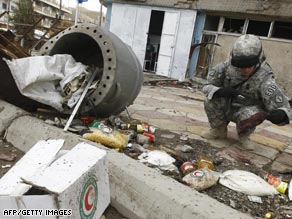
Misguided notions about the nature of justice continue to incite radicals to violence. Nearly 90 people in Iraq died in suicide bomber attacks. The first attack killed 55 people in the Diyala province, and 28 died in Baghdad. In addition, 67 people were wounded.
Article here: http://www.cnn.com/2009/WORLD/meast/04/23/iraq.violence/index.html
This, apparently, was not enough. Gunmen shot a police officer in Kirkuk, and three more people were killed (and seven injured, including children) near Baquba.
I think it is important to note that those killed in Diyala were unsuspecting pilgrims who had stopped at a restaurant for lunch. Are the attacks on such pilgrims just?
Justice in the Quran is taken to mean "balance," and is the foundation upon which creation stands. The fourth Caliph, Ali Ibn Abi Talib, defined justice as "the placement of everything in their proper order." Under this conception, proportionality and relation are essential components of justice. A peace which is based on justice would therefore mean a balanced, fair, and tranquil state. Muhammad is reported to have said,
"Mankind are the family of God, and the most beloved of them to God are those who are the most excellent to His family." "Not one of you believes until he loves for his brother what he loves for himself."
Great Muslim scholars such as Ibn Hajar al-Asqalani and Sharafuddin al Nawawi have said that the words "his brother" in the above quote refer to any person irrespective of faith. If "mankind are the family of God" then all human beings are included in that family.
It is natural for humans to desire peace and justice. But Muhammad states that we should love for our brothers what we love for ourselves. That is, if we desire peace and justice for ourselves, and we surely do, we must also desire peace and justice for others. This alone precludes unwarranted attacks on innocents. Further, aggressively attacking those who have done you no harm is in contradiction with Muhammad's injunction to treat all mankind excellently. Unprovoked attacks, perpetrated against the innocent no less, are entirely unjust and ought to be righteously condemned.
Muhammad, the Caliph, and Islamic scholars of historic reputation have all offerred conceptions of justice which demand respect for all mankind as part of God's family. From where, then, come the misguided notions which convince people to commit injustices against their fellows? If their cause encourages unjust means, is it not itself unjust?
Monday, April 27, 2009
Attacks on Christians
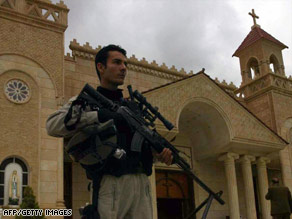
There is sad news to report today. In Iraq, recent attacks on Christian civilians have left three people dead. There were two attacks. In the first, attackers broke into a home in Kirkuk and slit the throats of a woman and her daughter-in-law. And in a nearby neighborhood, a group of soulless cowards with guns shot a father and his three sons, one of whom died.
Threats have been made in Mosul that Christians are to either convert to Islam or be killed.
Full story here: http://www.cnn.com/2009/WORLD/meast/04/26/iraq.christian.attacks/index.html
This is just disgusting.
Christians and Jews - referred to as "people of the Book" in the Quran - are supposed to be recognized as righteous people by Islam.
"And there are, certainly, among the People of the Book [Jews and Christians], those who believe in God, in the revelation to you, and in the revelation to them, bowing in humility to God: They will not sell the Signs of God for a miserable gain! For them is a reward with their Lord, and God is swift in account. (The Noble Quran, 3:199)"
"Those who believe (in the Quran),and those who follow the Jewish (scriptures), and the Christians and the Sabians, - any who believe in God and the Last Day, and work righteousness, shall have their reward with their Lord; on them shall be no fear, nor shall they grieve. (The Noble Quran, 2:62)"The cowards who perpetrated these attacks are obviously defying the Quran by illegitimately attacking Christians.Here's another thought:
"If anyone harms (others), God will harm him, and if anyone shows hostility to others, God will show hostility to him." Sunan of Abu-Dawood, Hadith 1625.
These malicious attackers, if they have any faith at all, can rest assured that they will receive their just punishment. But we can hope that they will recognize that their actions are unjust. They might want to re-read the book they claim to revere so highly.
Wednesday, April 22, 2009
Torture by Sheikh
A recent news story seems highly relevant here.
Check out this video: http://abcnews.go.com/video/playerIndex?id=2688465
What it shows is a man being tortured. His assailants? Sheikh Issa bin Zayed al Nahyan of the United Arab Emirates, brother of the country's crown prince, Sheikh Mohammed. The Sheikh is assisted by a man in a UAE police uniform. I, at least, find this quite troubling.
Read the full news story here: http://www.abcnews.go.com/Blotter/story?id=7402099&page=1
Sharia law is actually one of the earlier sources of the concept of inalienable human rights, and there is some evidence that it influenced John Locke (of "life, libery, and property" fame). Sharia law explicitly denies a ruler the "right to take away from his subjects certain rights which inhere in his or her person as a human being." Inalienable rights are referred to as such because they "become rights by reason of the fact that they are given to a subject by a law and from a source which no ruler can question or alter." The source referred to is Allah. So any ruler who infringes upon the inalienable rights granted to a human individual by Allah is refuting Allah. Who was it in that video again? Oh, a member of the UAE royal family, assisted by state police. Also, Muhammad is reported to have said that "mankind are the dependents, or family of God, and the most beloved of them to God are those who are the most excellent to His dependents." The blatant violation of ethics committed by the Sheikh is certainly not "excellent," and we can safely say that it does not make him beholden in the eyes of Allah.
What should happen to Islamic rulers who so clearly fail to uphold justice? Al-Mawardi said that if the rulers become either unjust or severely ineffective then the Caliph or ruler must be impeached via the Majlis ash-Shura. Al-Baghdadi believed that if the rulers do not uphold justice, the ummah via the majlis should first warn them, and if the warning were to go unheeded then the ruler can be impeached. Al-Juwayni argued that Islam is the goal of the ummah, and any ruler who deviates from this goal must be impeached. Al-Ghazali believed that oppression by a ruler is enough for impeachment. Rather than just relying on impeachment, Ibn Hajar al-Asqalani argued that the people are obligated to rebel if the ruler beginsto act with no regard for Islamic law. Ibn Hajar al-Asqalani said that to ignore a violation of justice by a ruler is haraam, and those who cannot revolt inside the caliphate should launch a struggle from outside.
I think this litany speaks for itself. I will be eagerly awaiting the outcry against Sheikh Issa bin Zayed al Nahyan.
Check out this video: http://abcnews.go.com/video/playerIndex?id=2688465
What it shows is a man being tortured. His assailants? Sheikh Issa bin Zayed al Nahyan of the United Arab Emirates, brother of the country's crown prince, Sheikh Mohammed. The Sheikh is assisted by a man in a UAE police uniform. I, at least, find this quite troubling.
Read the full news story here: http://www.abcnews.go.com/Blotter/story?id=7402099&page=1
Sharia law is actually one of the earlier sources of the concept of inalienable human rights, and there is some evidence that it influenced John Locke (of "life, libery, and property" fame). Sharia law explicitly denies a ruler the "right to take away from his subjects certain rights which inhere in his or her person as a human being." Inalienable rights are referred to as such because they "become rights by reason of the fact that they are given to a subject by a law and from a source which no ruler can question or alter." The source referred to is Allah. So any ruler who infringes upon the inalienable rights granted to a human individual by Allah is refuting Allah. Who was it in that video again? Oh, a member of the UAE royal family, assisted by state police. Also, Muhammad is reported to have said that "mankind are the dependents, or family of God, and the most beloved of them to God are those who are the most excellent to His dependents." The blatant violation of ethics committed by the Sheikh is certainly not "excellent," and we can safely say that it does not make him beholden in the eyes of Allah.
What should happen to Islamic rulers who so clearly fail to uphold justice? Al-Mawardi said that if the rulers become either unjust or severely ineffective then the Caliph or ruler must be impeached via the Majlis ash-Shura. Al-Baghdadi believed that if the rulers do not uphold justice, the ummah via the majlis should first warn them, and if the warning were to go unheeded then the ruler can be impeached. Al-Juwayni argued that Islam is the goal of the ummah, and any ruler who deviates from this goal must be impeached. Al-Ghazali believed that oppression by a ruler is enough for impeachment. Rather than just relying on impeachment, Ibn Hajar al-Asqalani argued that the people are obligated to rebel if the ruler beginsto act with no regard for Islamic law. Ibn Hajar al-Asqalani said that to ignore a violation of justice by a ruler is haraam, and those who cannot revolt inside the caliphate should launch a struggle from outside.
I think this litany speaks for itself. I will be eagerly awaiting the outcry against Sheikh Issa bin Zayed al Nahyan.
Subscribe to:
Posts (Atom)