Wednesday, April 29, 2009

The Injustice of Suicide Bombing


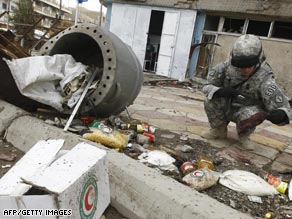
Misguided notions about the nature of justice continue to incite radicals to violence. Nearly 90 people in Iraq died in suicide bomber attacks. The first attack killed 55 people in the Diyala province, and 28 died in Baghdad. In addition, 67 people were wounded.

Article here: http://www.cnn.com/2009/WORLD/meast/04/23/iraq.violence/index.html

This, apparently, was not enough. Gunmen shot a police officer in Kirkuk, and three more people were killed (and seven injured, including children) near Baquba.

I think it is important to note that those killed in Diyala were unsuspecting pilgrims who had stopped at a restaurant for lunch. Are the attacks on such pilgrims just?

Justice in the Quran is taken to mean "balance," and is the foundation upon which creation stands. The fourth Caliph, Ali Ibn Abi Talib, defined justice as "the placement of everything in their proper order." Under this conception, proportionality and relation are essential components of justice. A peace which is based on justice would therefore mean a balanced, fair, and tranquil state. Muhammad is reported to have said,

"Mankind are the family of God, and the most beloved of them to God are those who are the most excellent to His family." "Not one of you believes until he loves for his brother what he loves for himself."

Great Muslim scholars such as Ibn Hajar al-Asqalani and Sharafuddin al Nawawi have said that the words "his brother" in the above quote refer to any person irrespective of faith. If "mankind are the family of God" then all human beings are included in that family.

It is natural for humans to desire peace and justice. But Muhammad states that we should love for our brothers what we love for ourselves. That is, if we desire peace and justice for ourselves, and we surely do, we must also desire peace and justice for others. This alone precludes unwarranted attacks on innocents. Further, aggressively attacking those who have done you no harm is in contradiction with Muhammad's injunction to treat all mankind excellently. Unprovoked attacks, perpetrated against the innocent no less, are entirely unjust and ought to be righteously condemned.

Muhammad, the Caliph, and Islamic scholars of historic reputation have all offerred conceptions of justice which demand respect for all mankind as part of God's family. From where, then, come the misguided notions which convince people to commit injustices against their fellows? If their cause encourages unjust means, is it not itself unjust?

Monday, April 27, 2009

Attacks on Christians


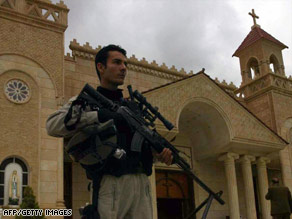
There is sad news to report today. In Iraq, recent attacks on Christian civilians have left three people dead. There were two attacks. In the first, attackers broke into a home in Kirkuk and slit the throats of a woman and her daughter-in-law. And in a nearby neighborhood, a group of soulless cowards with guns shot a father and his three sons, one of whom died.

Threats have been made in Mosul that Christians are to either convert to Islam or be killed.

Full story here: http://www.cnn.com/2009/WORLD/meast/04/26/iraq.christian.attacks/index.html

This is just disgusting.

Christians and Jews - referred to as "people of the Book" in the Quran - are supposed to be recognized as righteous people by Islam.

"And there are, certainly, among the People of the Book [Jews and Christians], those who believe in God, in the revelation to you, and in the revelation to them, bowing in humility to God: They will not sell the Signs of God for a miserable gain! For them is a reward with their Lord, and God is swift in account. (The Noble Quran, 3:199)"

"Those who believe (in the Quran),and those who follow the Jewish (scriptures), and the Christians and the Sabians, - any who believe in God and the Last Day, and work righteousness, shall have their reward with their Lord; on them shall be no fear, nor shall they grieve. (The Noble Quran, 2:62)"The cowards who perpetrated these attacks are obviously defying the Quran by illegitimately attacking Christians.

Here's another thought:
"If anyone harms (others), God will harm him, and if anyone shows hostility to others, God will show hostility to him." Sunan of Abu-Dawood, Hadith 1625.

These malicious attackers, if they have any faith at all, can rest assured that they will receive their just punishment. But we can hope that they will recognize that their actions are unjust. They might want to re-read the book they claim to revere so highly.

Wednesday, April 22, 2009

Torture by Sheikh

A recent news story seems highly relevant here.

Check out this video: http://abcnews.go.com/video/playerIndex?id=2688465

What it shows is a man being tortured. His assailants? Sheikh Issa bin Zayed al Nahyan of the United Arab Emirates, brother of the country's crown prince, Sheikh Mohammed. The Sheikh is assisted by a man in a UAE police uniform. I, at least, find this quite troubling.

Read the full news story here: http://www.abcnews.go.com/Blotter/story?id=7402099&page=1

Sharia law is actually one of the earlier sources of the concept of inalienable human rights, and there is some evidence that it influenced John Locke (of "life, libery, and property" fame). Sharia law explicitly denies a ruler the "right to take away from his subjects certain rights which inhere in his or her person as a human being." Inalienable rights are referred to as such because they "become rights by reason of the fact that they are given to a subject by a law and from a source which no ruler can question or alter." The source referred to is Allah. So any ruler who infringes upon the inalienable rights granted to a human individual by Allah is refuting Allah. Who was it in that video again? Oh, a member of the UAE royal family, assisted by state police. Also, Muhammad is reported to have said that "mankind are the dependents, or family of God, and the most beloved of them to God are those who are the most excellent to His dependents." The blatant violation of ethics committed by the Sheikh is certainly not "excellent," and we can safely say that it does not make him beholden in the eyes of Allah.

What should happen to Islamic rulers who so clearly fail to uphold justice? Al-Mawardi said that if the rulers become either unjust or severely ineffective then the Caliph or ruler must be impeached via the Majlis ash-Shura. Al-Baghdadi believed that if the rulers do not uphold justice, the ummah via the majlis should first warn them, and if the warning were to go unheeded then the ruler can be impeached. Al-Juwayni argued that Islam is the goal of the ummah, and any ruler who deviates from this goal must be impeached. Al-Ghazali believed that oppression by a ruler is enough for impeachment. Rather than just relying on impeachment, Ibn Hajar al-Asqalani argued that the people are obligated to rebel if the ruler beginsto act with no regard for Islamic law. Ibn Hajar al-Asqalani said that to ignore a violation of justice by a ruler is haraam, and those who cannot revolt inside the caliphate should launch a struggle from outside.

I think this litany speaks for itself. I will be eagerly awaiting the outcry against Sheikh Issa bin Zayed al Nahyan.

Sunday, April 12, 2009

Misguided Militancy

I came across this article the other day: http://www.reuters.com/article/featuredCrisis/idUSISL476198

Here are a few select quotes:
"If infidels occupy a Muslim land then it's obligatory for all Muslims to do jihad ... Preaching jihad is my duty," [Noor Muhammad] said.

"We spread the message that the Taliban and Osama (bin Laden) have adopted the right path and that's the solution of all problems," Muhammad said.

"The protection of Koranic teachings is only possible through arms .... those who make weapons, make them available and use them will go to heaven," said Muhammad

"The love and affection for jihad have developed among the youth to the extent that neither their relatives nor the government can control them," [Muhammad] said.

So according to Noor Muhammad, the protection of Koranic teachings should be accomplished by a cadre of militant weapons dealers who cannot be controlled by the very social and political institutions which they ostensibly support. That's wonderfully coherent... either he's looking to create anarchy or he's using support for the Taliban and Osama bin Laden as a vehicle to advance his own political agenda. Since Muhammad claims to have a particular ideological outcome in mind (protection of Koranic teachings), he cannot be seeking anarchy. Which means that he's intent on advancing his own political agenda.

Al-Farabi had something to say about this kind of thing. He described the perfect society as one which is ordered towards "true happiness" (philosophical/spiritual enlightenment). The perfect society is virtuous while all others are vicious. Al-Farabi describes three types of vicious society: errant, wicked, and ignorant. Both wicked and errant societies understand the true human end to be "true happiness," but fail to achieve it. Errant societies are those which have been deceived and misled by their leaders. Wicked societies are those which have willfully abandoned the pursuit of happiness. And ignorant societies are those which do not recognize the proper end of life and instead substitute something lesser, such as sensual pleasure or power.

Now, I don't know whether Muhammad understands the proper end of life or not, but he at least is willfully misleading his followers to achieve militant conquest rather than enlightenment.

Al-Farabi tells us that the role of the philosopher in society is to act as a kind of physician, seeking to "balance the humours" by communicating abstract truths to ordinary people, leading them toward virtue. There are also "weeds," individuals who are like anti-philosophers, attempting to undermine the progress of society towards virtue.

The virtuous society can never be established through such unvirtuous means as militant conquest unchecked by social or legal mores, and Noor Muhammad is one of Al-Farabi's "weeds."

Now where are my garden shears...

Welcome!

Western philosophy is often viewed as having very little consequence. If asked about the effect philosophy has on their lives, most Westerners, if they even knew what philosophy was, would probably answer that it affects them very little or not at all.

Why is this?

Well, philosophy and religion are the two vehicles through which humans attempt to discover what is true. And truths affect people when they are put into practice, usually through institutions like churches or governments. We would expect the greatest effect to be achieved when these institutions are most closely tied together. But in the West they are not tied at all. America has codified the separation of church and state, and its universities have largely secularized the study of philosophy. Even political philosophy has a negligible effect in a popular democracy. When philosophy has no dialogue with either church or state, its effect is vastly diminished.

What I find interesting about Islamic philosophy is the way in which it is tied into the fabric of society. Muslim governments are overtly religiously-influenced. This means that the way religion is interpreted has direct political effects. And in a society where religion is of such great importance, philosophy will tend to either explicitly or implicitly address religious questions. So one might say that in a certain sense all Islamic philosophy is political.

The way that actions in the Islamic community exemplify a philosophical position or the way in which philosophical arguments play out in the arena of human behavior is a very good reason to pay attention to Islamic philosophy and its history.